
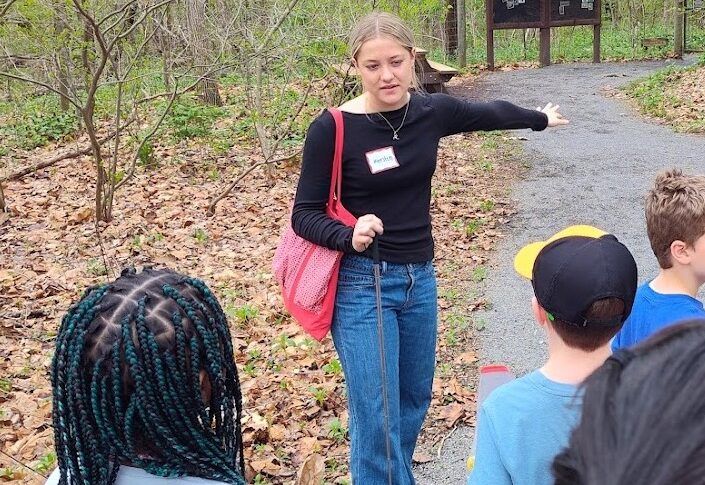
When Kersten Sykes ’28 joined the Wildflower Exploration Program at Cornell’s Mundy Wildflower Garden, she was expecting a challenge — and found a calling. The nutritional sciences major, on an M.D.-Ph.D. track in the College of Human Ecology, had no background in environmental science, yet here she was as a program assistant, teaching local third-graders about the life cycle of perennial flowers, sustainability concepts and Indigenous traditions.
Through the Community Work-Study Program (CWSP), Sykes quickly immersed herself in the content. She created study guides and visual aids to support both students and volunteers in understanding the plants they encountered. “I got really into it,” she said. “It exceeded my expectations.”
The experience reshaped how she thinks about education. “Teaching isn’t a trickle-down — it’s an interactive web,” Sykes reflected. Working side-by-side with retirees, community volunteers and Botanic Gardens staff creates a vibrant intergenerational learning environment where knowledge flows in many directions. Sykes, for one, built skills in communication, collaboration and mentorship — tools she plans to apply in her future healthcare career.
The impact on the community is equally meaningful. The program offers third-graders a rare opportunity to explore a local ecosystem hands-on and connect with college students who make environmental stewardship feel exciting and accessible — sparking curiosity that carries beyond the garden. Some children hold on to their wildflower guides for years, and parents recall the experience long after. “It sends a message that it’s cool to care about the environment,” said Lauren Salzman, Youth Education and Learning by Leading Coordinator at Cornell Botanic Gardens.
Seeing children’s enthusiasm for discovery — and knowing she played a part in igniting it — has inspired Sykes’s continued interest. “I definitely want to do this again next spring,” she said. “It was a really unique and rewarding experience.”
This story is part of a series highlighting Cornell’s Community-Work Study Program.